
Tools
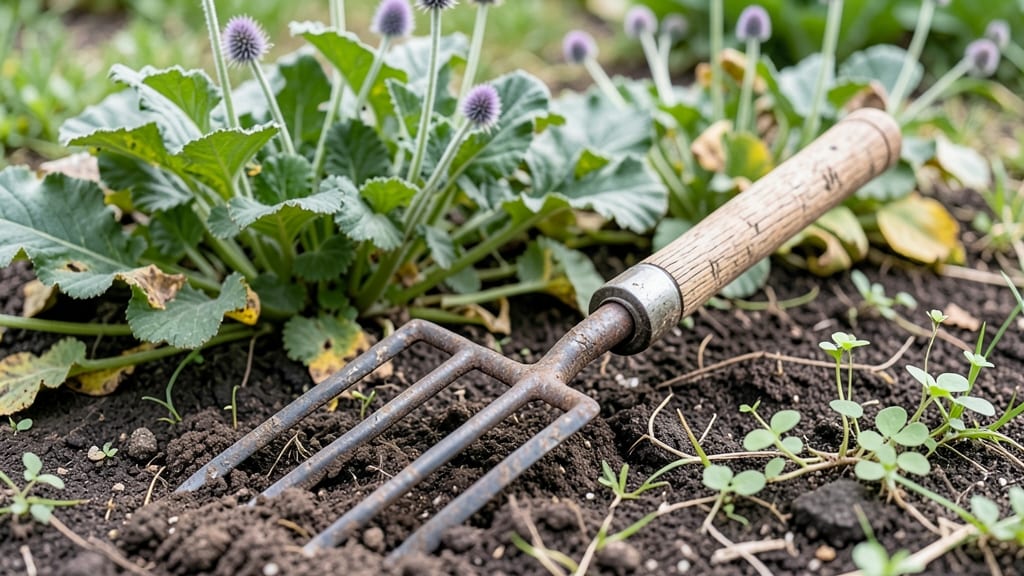
A garden fork's four sturdy tines act like soil surgeons, slicing through dense clay without tearing plant roots. Unlike spades that cut cleanly, forks pry and lift—perfect for turning compost into garden beds without creating a mess.
I’ve used mine to extract dahlia tubers in fall without damaging the crown, or to break up hardpan before planting garlic. The key is the angle: hold it like a dagger for precision work, or drive it straight down for heavy-duty aeration. 🌱
For tasks like harvesting potatoes or removing sod, the fork’s leverage lets you work deeper with less effort than a shovel. Just avoid using it for fine seedbeds—its tines are too aggressive for delicate soil.
Think of it as your go-to tool for anything requiring force and aeration, from amending soil to clearing stubborn weeds from lawn edges.
💡 In This Article
- How a Garden Fork’s Tines Improve Soil Health
- 10 Tasks Where a Garden Fork Outperforms Other Tools
How a garden fork’s tines improve soil health
The secret lies in a garden fork’s four triangular tines, spaced about 2-3 inches apart and angled at 45 degrees.
This design creates a mechanical advantage when penetrating soil: instead of slicing like a spade, the tines wedge between soil particles, breaking up clay and compacted layers without tearing plant roots.
Think of it like a prying action—each tine acts as a lever, applying force downward while the gaps between them allow air and water to penetrate deeper. This is why forks excel at aerating hardpan, where spades would just push the compacted layer aside. 🌱
Soil scientists call this process macro-porosity enhancement, which is critical for root growth. When you drive a fork into clay soil, the tines create vertical channels that improve water infiltration by up to 40% compared to undisturbed soil.
These channels also allow earthworms and beneficial microbes to move more freely, accelerating organic matter breakdown. The key difference from a trowel? A trowel’s flat edge compresses soil as you work, while fork tines lift and separate particles, creating a looser, more oxygen-rich environment for roots.
Here’s what happens at the microscopic level: compacted clay particles are held together by capillary forces, but the fork’s tines disrupt these bonds by physically separating them. This breaks the hardpan’s structure while leaving larger root systems intact—a critical feature when transplanting perennials or dividing shrubs.
The 3-4 inch spacing between tines also prevents soil from clumping around them, making it easier to remove and turn without creating a mess like a spade would. 💫
For drainage improvement, consider this: clay soil’s poor permeability stems from tightly packed particles that trap water. A garden fork’s tines create vertical channels that bypass this layering effect, allowing water to drain 2-3 times faster through the affected zone.
This is especially valuable in heavy clay gardens where water pools on the surface. The fork’s design also makes it ideal for incorporating compost—the tines lift and mix amendments into the soil without burying them too deeply, unlike a shovel that might compact the mix.
What most gardeners don’t realize is how the fork’s weight distribution matters. The long handle and broad head mean you’re applying force through the entire length of the tool, not just your arms.
This leverage lets you penetrate 12-18 inches deep with minimal effort, compared to a spade that might only go 6-8 inches before meeting resistance. The result? More thorough aeration with less physical strain—a win for both your garden and your back. 🔥
For comparison, a standard trowel’s flat blade can’t match this depth or aeration capacity. While trowels are perfect for edging or planting small seeds, their 1-2 inch working depth makes them useless for breaking up hardpan.
The fork’s tines, however, act like tiny plows, creating the ideal environment for root systems to expand downward while improving overall soil structure over time.