
Pests
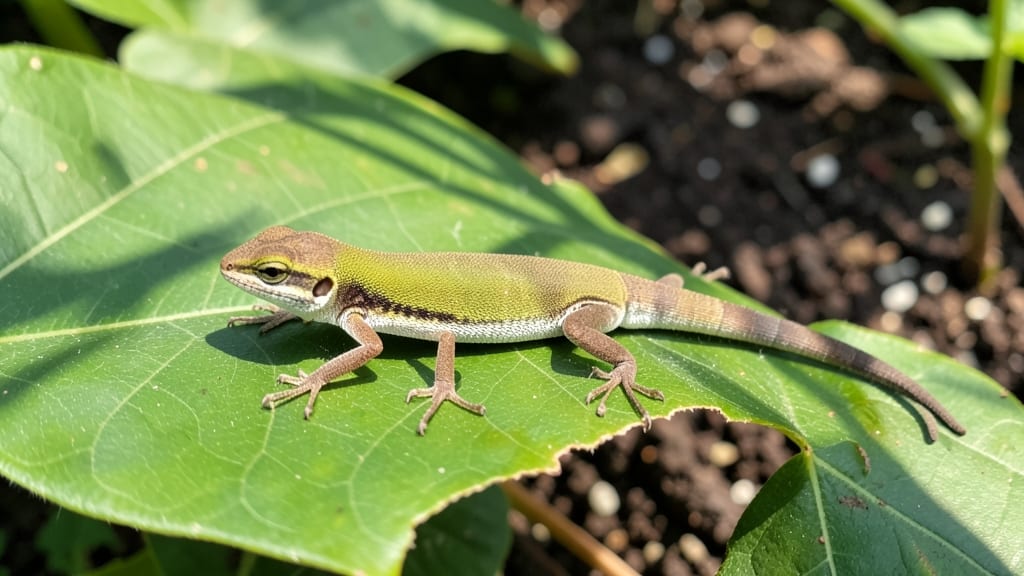
Identifying common garden lizards involves spotting species like anoles, skinks, and fence lizards, which typically measure 2-6 inches long, have slender bodies, and thrive near gardens, fences, or sunny rocks. Their distinguishing features include keeled scales, crests, or vibrant color patterns like green backs or blue throats.
These small reptiles are often mistaken for insects or pests, but they actually play a crucial role in controlling garden pests like spiders and ticks. 🌿 Their preference for sunny, sheltered spots means you’ll most likely find them basking on warm stones, climbing low fences, or darting between leafy plants.
Unlike snakes, they’re harmless to humans and even help maintain ecological balance by preying on smaller insects.
If you’re trying to attract them to your yard, focus on creating microhabitats with flat rocks for basking, dense ground cover for shelter, and shallow water sources. I’ve noticed they’re most active during warm, sunny days—perfect for quick identification during spring and summer months when they’re most visible.
💡 In This Article
- Physical Traits of Garden Lizards by Species
- Where to Spot Garden Lizards in Your Yard
Physical traits of garden lizards by species
Anoles, skinks, and fence lizards each have unique physical adaptations shaped by their environments. Anoles typically measure 2-5 inches and feature dewlap skin flaps under their chins, which they extend for communication.
Their scales are smooth and often brightly colored—think emerald green backs or turquoise throats—to blend into foliage while hunting insects. Skinks, slightly larger at 3-6 inches, have shiny, overlapping scales and often reduced limbs or none at all (like the glass lizard), giving them a sleek, serpentine appearance.
Their tails tell another story: anoles possess fragile, easily detachable tails that regenerate, while skinks have thicker, muscular tails for balance and fat storage. Fence lizards, like the common five-lined skink, sport distinct dark stripes along their bodies and orange or red bellies when threatened, a warning to predators.
Habitat directly influences these traits—foliage-dwelling anoles evolve flatter bodies for climbing, while ground-dwelling skinks develop stouter limbs for burrowing.
Scale texture is a key differentiator: anoles have granular, slightly rough scales, while skinks boast smooth, almost glassy scales that reflect light. This variation isn’t just cosmetic—it affects thermoregulation.
Smooth scales on skinks absorb and retain heat more efficiently, ideal for their sun-basking habits, whereas anoles’ rougher scales help dissipate heat in shadier microclimates. 🌿 The blue throat of male anoles, for instance, isn’t just for show; it’s a UV-reflective signal to attract mates and intimidate rivals.
Regional variations add another layer: in the southeastern U.S., anoles may appear darker brown to camouflage among leaf litter, while their western counterparts stay brighter green. Skinks in arid regions, like the great plains skink, develop lighter, sandy hues to match their rocky habitats.
These adaptations aren’t random—they’re evolutionary responses to predation pressure, temperature, and food availability. For example, a blue-tailed skink’s vibrant tail isn’t just pretty; it’s a distraction mechanism to lure predators away from its vulnerable body.
One often-overlooked trait is their eye structure: most garden lizards have round pupils that dilate like a cat’s, but skinks often exhibit vertical slits, a trait inherited from their snake-like ancestors. This adaptation helps them track prey more efficiently in low-light conditions, like early mornings or late afternoons.
Their quick, lateral tongue flicks (up to 10 times per second) also serve a dual purpose: detecting chemical cues in the air and cooling their bodies through evaporation.
Understanding these traits helps with identification—and appreciation. Next time you spot a green flash darting across your garden, take a closer look: is it an anole with a dewlap or a skink with smooth scales?
The answer reveals not just the species, but the hidden ecosystem thriving right under your nose. 💫