Pests
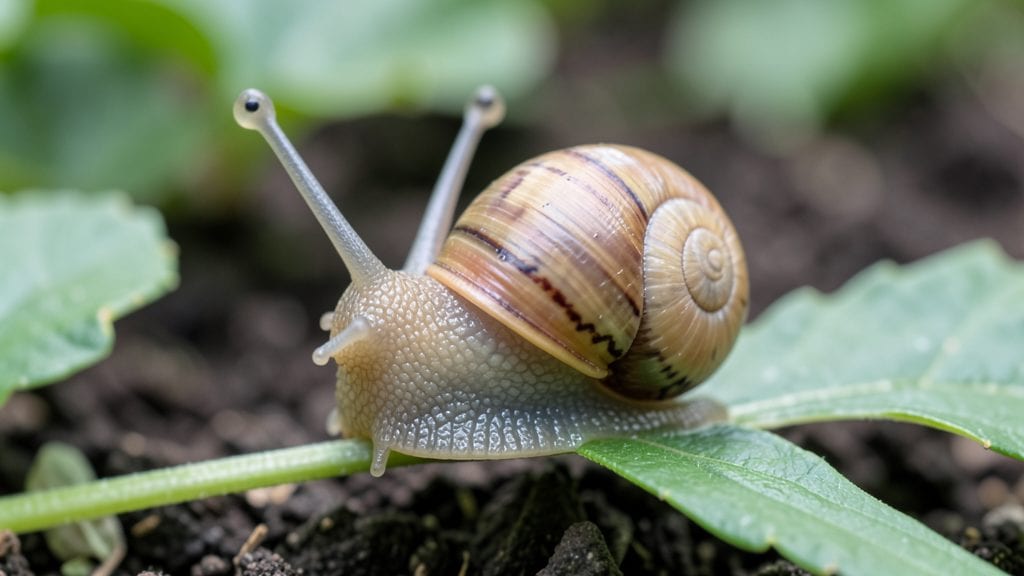
Understanding garden snail anatomy reveals why these pests thrive in gardens: their soft, muscular bodies, coiled shells for protection, retractable eyes and tentacles for threat detection, and slimy mucus trails that aid movement and moisture retention. Their digestive system efficiently breaks down plant matter, producing waste that damages garden health.
Garden snails pack a surprising amount of specialized biology into their small bodies. 🔥 Their radula—a tiny, sandpaper-like tongue—scrapes plant surfaces with razor-sharp teeth, while the foot sole secretes mucus to glide effortlessly over obstacles.
The coiled shell isn't just armor; its spiral pattern helps them right themselves when flipped, and the eyestalks can retract instantly if disturbed. These adaptations explain why they're so hard to eradicate—they're built for survival in your garden's most vulnerable spots.
What's fascinating is how their anatomy directly translates to damage patterns. The mucus trails they leave behind aren't just a telltale sign—they're also a moisture highway that helps snails navigate toward your most tender plants.
Their waste, rich in nitrogen, might even seem like fertilizer at first glance, but it actually burns young seedlings by disrupting soil chemistry. This dual nature makes them both a nuisance and a biological puzzle worth studying.
💡 In This Article
- How Garden Snail Body Parts Enable Garden Damage
- Identifying Snail Shells and Mucus Trails for Control
How garden snail body parts enable garden damage
The radula—a ribbon-like structure covered in thousands of tiny, chitinous teeth—is the snail's primary weapon against plants.
These teeth, arranged in rows like a saw blade, can exert 10-20 pounds of pressure per square inch, allowing snails to scrape through leaf surfaces with surgical precision. 🔥 The radula's teeth are constantly replaced (up to 10,000 teeth per day), making it nearly indestructible.
This relentless feeding creates jagged edges on leaves and stems, which then become entry points for fungal infections.
The foot sole, which covers about 60-70% of their body mass, secretes a dual-purpose mucus that's both a lubricant and a biological shield.
This slime contains glycoproteins that reduce friction by 90% while also acting as a moisture barrier—snails can survive 3-5 days without water because their mucus prevents dehydration.
The trail they leave behind isn't random; it contains chemical signals that guide other snails to food sources, creating coordinated feeding patterns that can strip entire seedlings overnight.
Their eyestalks and tentacles serve as a 360-degree early warning system. The upper tentacles (with 1,000+ sensory cells) detect vibrations and chemical cues from predators like birds or frogs, while the lower tentacles (with eyes at the tips) provide 360-degree vision.
When threatened, they can retract these appendages in 0.2 seconds, making them nearly invisible to predators. This survival mechanism explains why snails often appear suddenly in your garden—they've been there for hours, undetected, while their radulas were busy destroying your plants.
The coiled shell isn't just protective armor—its spiral design helps snails right themselves when flipped, a process called "negative geotaxis." The shell's calcium carbonate composition makes it 3-5 times harder than human fingernails, while its weight distribution allows snails to carry it at 1/3 of their body weight without strain.
This mobility means they can access plants at ground level where seedlings are most vulnerable, often targeting the most tender new growth that's rich in nutrients and water.
What makes snails particularly damaging is their digestive system, which converts plant matter into waste that's 30-50% nitrogen-rich.
While this might seem like fertilizer, the high ammonia content actually burns young plant roots by disrupting soil pH. A single snail can produce 0.1-0.3 grams of waste per day, and in dense infestations, this creates a toxic environment that stunts growth and attracts more pests.
The combination of physical damage from feeding and chemical damage from waste creates a double threat to garden health.
Their anatomy creates a perfect storm of destruction: the radula's precision, the foot's mobility, the shell's protection, and the waste's toxicity all work together to turn gardens into their personal buffet. Understanding these mechanisms helps explain why traditional methods often fail—snails are biologically engineered to exploit garden weaknesses. 💫