Tools
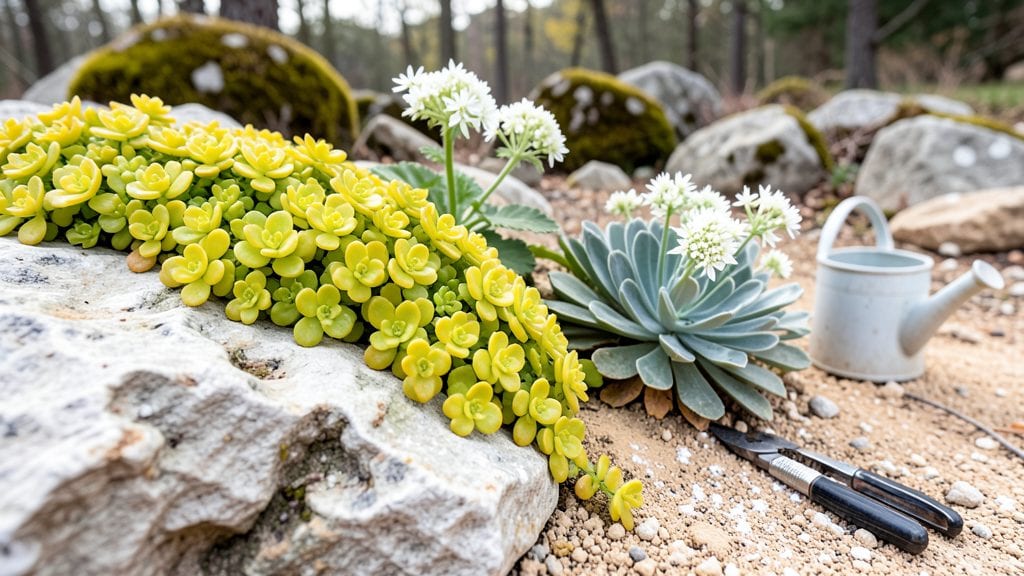
Using limestone in your garden naturally raises soil pH, neutralizes acidity, and improves drainage for acid-sensitive plants like azaleas, blueberries, and vegetables. Apply 1-2 pounds per 100 square feet for gradual adjustment, testing soil annually for optimal balance.
Limestone works because its calcium carbonate content reacts with acidic soil compounds, gradually converting them into neutral salts. 🔥 This slow-release process prevents sudden pH spikes that can harm plant roots.
For best results, I recommend using pelletized limestone—it dissolves more evenly than coarse chunks, ensuring consistent pH adjustment across your garden beds. Many gardeners overlook magnesium levels, but dolomitic limestone adds this essential nutrient, making it ideal for magnesium-deficient soils like those found in sandy regions.
When applying, focus on areas where soil tests reveal pH below 6.5. For lawns, spread evenly with a broadcast spreader, while vegetable beds benefit from mixing granules into the top 6 inches of soil during spring or fall.
Always water thoroughly after application to activate the chemical reaction—this helps prevent surface crusting that can block root access to nutrients.
💡 In This Article
- How Limestone Adjusts Soil pH Chemistry
- Best Garden Applications for Limestone Granules
How limestone adjusts soil pH chemistry
When you add limestone to acidic soil, the calcium carbonate (CaCO₃) reacts with hydrogen ions (H⁺) in the soil solution, forming calcium bicarbonate (Ca(HCO₃)₂) and water (H₂O). This chemical reaction—called neutralization—gradually reduces soil acidity by converting harmful hydrogen ions into neutral compounds.
The process is slow (weeks to months) because limestone dissolves at a rate of about 0.5-1.0 pH units per year, depending on soil moisture and organic matter content. This gradual adjustment prevents sudden pH spikes that could damage plant roots.
The type of limestone matters significantly. Calcitic limestone (pure calcium carbonate) primarily raises pH, while dolomitic limestone (calcium-magnesium carbonate) adds magnesium, an essential nutrient for plant enzymes and chlorophyll production.
For magnesium-deficient soils (common in sandy areas), dolomitic limestone is ideal—it provides both pH adjustment and a 2:1 calcium-to-magnesium ratio. Particle size also plays a role: finer granules (10-20 mesh) dissolve faster, while coarse chunks (3-4 mesh) last longer but may create uneven pH distribution.
Here's what's happening at the microscopic level: Soil acidity comes from organic acids (like humic acid) and aluminum/hydrogen ions released by clay minerals. When limestone dissolves, calcium ions replace these harmful ions on soil particle surfaces, improving nutrient availability.
The reaction continues as long as acidic compounds are present, making limestone a self-regulating amendment.
For example, in a pH 5.0 soil, applying 5 pounds of limestone per 100 sq ft might raise pH to 6.5 over 6 months, but annual testing ensures you don't overshoot the target for sensitive plants.
Texture changes also occur: Limestone improves soil structure by reducing clay particle aggregation in acidic conditions. The calcium ions help bind fine particles, creating larger aggregates that enhance aeration and drainage. This is why limestone works well in compacted or heavy clay soils where roots struggle to penetrate.
The physical transformation—from dense, acidic clay to looser, alkaline-friendly soil—is often visible within 3-6 months of consistent application. 🔥
One common misconception is that limestone only works in sandy soils. In reality, it's equally effective in clay because the chemical reaction occurs in the soil solution, not just the solid matrix.
However, clay soils may require 20-30% more limestone due to their higher cation exchange capacity (they hold more acidic ions). For instance, a clay soil with pH 4.8 might need 8 pounds per 100 sq ft to reach pH 6.5, compared to 5 pounds for sandy soil.
Testing before and after application reveals the magic: A soil test showing 1.2 meq/100g exchangeable aluminum before limestone might drop to 0.3 meq/100g afterward, eliminating aluminum toxicity that stunts root growth.
This chemical transformation explains why limestone is the gold standard for acid-loving plants like blueberries (pH 4.5-5.5) that suddenly thrive when their soil pH is raised to 6.0-6.5. The key is patience—limestone doesn't work overnight, but its long-term benefits make it worth the wait. ✨
For gardeners who want to see immediate results, blending limestone with compost creates a "buffered" effect where microbial activity accelerates the pH adjustment. The organic acids in compost temporarily lower pH, but the limestone neutralizes them faster than in mineral soil alone.
This dual-action approach is perfect for vegetable gardens where you need pH 6.0-7.0 for optimal nutrient uptake. 💫